

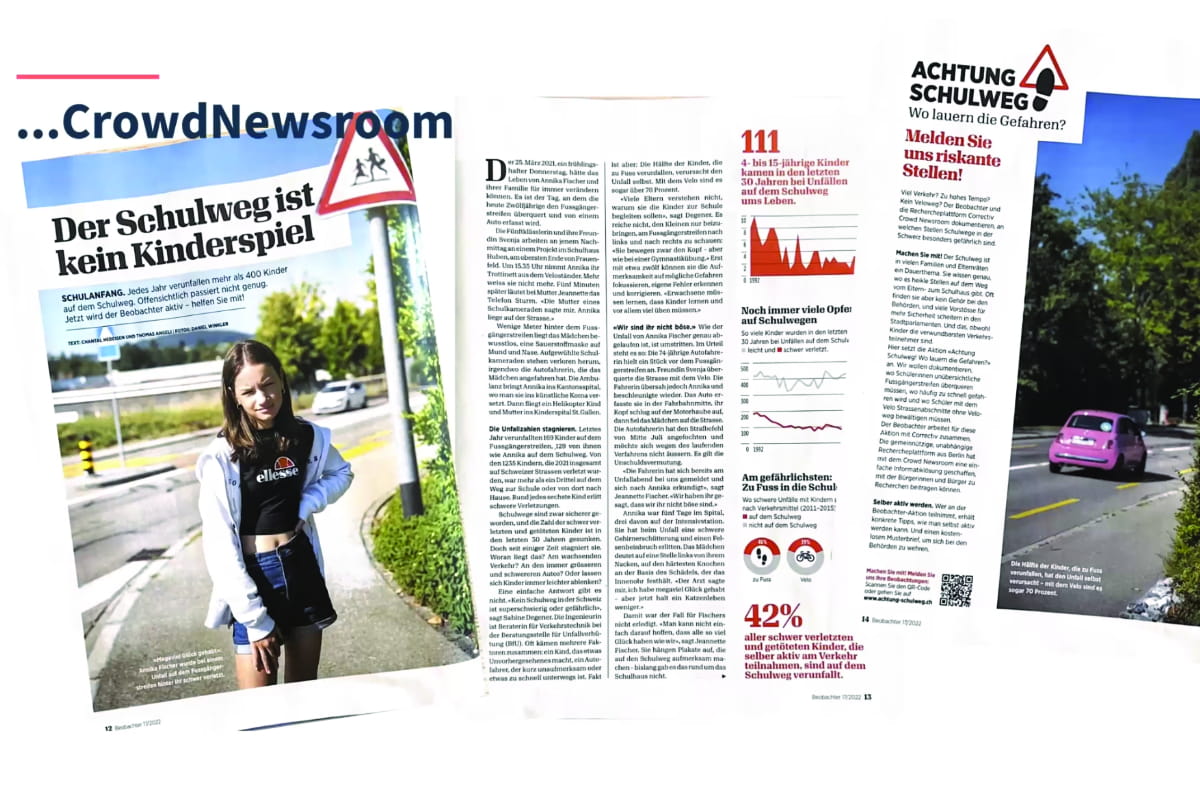
Crowd-centered investigations are a journalistic tool for harnessing the collective intelligence of the community. Finding out who the biggest players in the housing market of one’s hometown are isn’t easy in Germany. So why not ask, on a large scale, the people who would know? The tenants themselves.
In our beabee Lunchbreak in September, we welcomed Marc Engelhardt as a guest. Marc spent many years working as a reporter around the world. For some time now, he has been leading the CrowdNewsroom at CORRECTIV, a platform for crowd-centered investigations.
Using a recent crowd-centered investigation from Switzerland as an example, he explained the phases that every crowd investigation goes through. The framework Marc developed with the CrowdNewsroom can be applied repeatedly to community-driven investigations.
The CrowdNewsroom and Beobachter :
The CrowdNewsroom is a tool developed by CORRECTIV for crowd-centered investigations, enabling editorial teams to create complex surveys and use the results for their reporting.
Beobachter is a Swiss magazine, published every two weeks, focusing primarily on consumer and advisory topics.
These are crowd-centered investigations:
- Involving the community in investigations and developing content together with people is a core task in community journalism.
- There are different levels of involvement, ranging from open questions like “Which topics are on your mind?” to complex crowd-powered investigations on a very specific subject.
- Crowd-centered investigations are essentially structured interviews conducted with a large number of people. The answers can then be used to tell individual stories, or ideally, to uncover larger patterns and connections.
- The CrowdNewsroom defines crowd investigations on its website as follows: “Normally, journalists research on their own and then publish the results. Investigations with the CrowdNewsroom are different. Those affected – tenants, football players, cyclists, and many more – share their knowledge, important data, and input, creating the basis for journalistic analysis. This illuminates the topics that really matter to the community.”
The Framework for Crowd-Investigations:
- Start Phase: The focus in this phase is on defining the central research interest and breaking it down into a concrete research question that many people can relate to. In the case of the school route investigation, the question was: “Watch out on the school route – where are the dangers?” It is also useful in this phase to bring partners on board who can assist with the investigation. For this project, the partners included a large foundation for child and youth development, a digital parenting magazine, and the Mercator Foundation as a funder.
- Concept Phase: The second phase is classic journalistic work: structuring the interview. How should the survey be designed to sufficiently answer the research question? All project partners should collaborate and create a flow chart. The best approach is a large pinboard so that everyone can maintain an overview, even in complex surveys. It’s also crucial to determine what evidence participants must provide to verify their answers. The rule here is: as low-threshold as possible, as demanding as necessary. In the school route investigation, participants had to submit photos of dangerous spots.
- Build Phase: Once a solid concept exists, this is the easiest phase – simply translating the flow chart into a survey.
- Campaign Phase: The goal of the campaign is to motivate as many people as possible to participate. Especially in local contexts, creativity is key: events can be organized, or guerrilla marketing tactics considered. In the school route investigation, the goal was to reach as many parents of schoolchildren across Switzerland as possible. The campaign primarily focused on reaching parents via WhatsApp groups. The team created a standard message and a shareable graphic, which were widely circulated. Project partners with connections to parent organizations also played an important role.
- Analysis Phase: By the end of the survey, around 600 responses had been collected for the school route investigation. Analysis, however, begins on day one – not only after the survey ends. Even while the survey is ongoing, it can be valuable to publish individual stories to energize the campaign and provide early results back to the community. During deeper analysis afterward, significant journalistic effort is needed: Are there larger connections between the responses? Do certain patterns appear repeatedly? This usually offers many leads for further investigations.
Lessons Learned:
- Find the Right Partners: In crowd-centered investigations, the community is key. Involving partners is essential to make the campaign successful. The most important question is: how can we reach as many people as possible who care about the investigation? This leads directly to the next point.
- Pick the Low-Hanging Fruit: At the start of the school route investigation campaign, the team also contacted all employees of Beobachter Verlag, asking them to forward the WhatsApp template to their own parent groups.
- What’s in It for Me?: Participants should always be given the opportunity to take action themselves. In the school route investigation, for example, participants received a sample letter after completing the survey, which allowed them to report the dangerous spot to the responsible government authority.
- Deliver on Your Promises: In a crowd-centered investigation, you enter an implicit contract with the participants. They give you their time and trust. In return, they receive the results of the investigation they contributed to. That’s why you should ensure from Phase 1 that you can actually deliver at the end.
- A Crowd Investigation Generates Attention for You: A successful campaign for a crowd investigation is always also publicity for your own media outlet. Participants are potential members. People see that a different form of journalism is being practiced. It doesn’t necessarily matter how groundbreaking the results are – the process itself generates important attention.
This case study was first published in our beabee newsletter, where we share hands-on tips and guidance on community journalism every month. Subscribe here: Sign up
Do you have your own experiences or use cases that we should include? Just send an email to svenja.schilling@correctiv.org.