

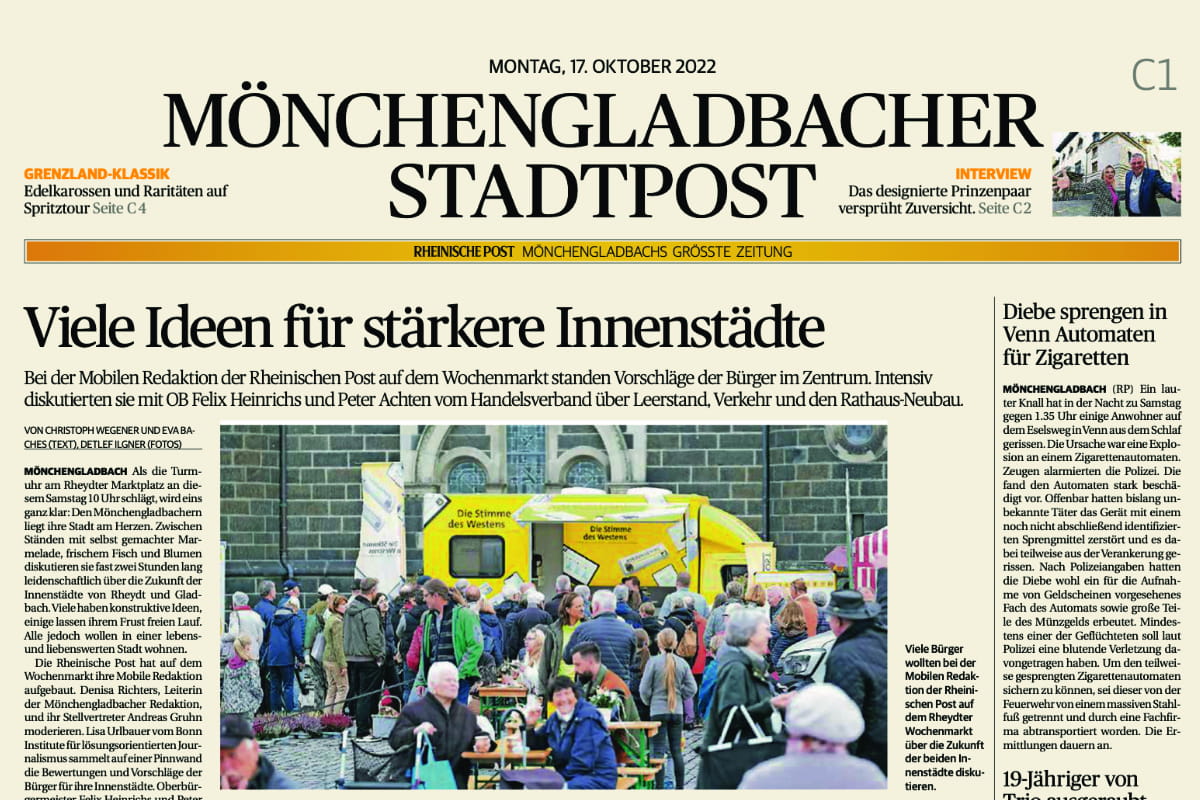
Solution journalism and local journalism – do they fit together? The Bonn Institute wanted to find out and worked closely last year with the local editorial team of the Rheinische Post in Mönchengladbach.
Between June and November 2022, the local editorial team published 20 solution-oriented stories focused on downtown development. The workflow they developed to move from a topic to a solution-focused story can be applied to many other subject areas and is easy to replicate.
From a Topic to a Solution-Oriented Story
The process essentially involves four steps, like using a microscope: first zoom in closer and closer, and then finally lift your head again to look around. The four steps are:
Step 1: Identify the Topic Area
First, the editorial team needed to identify a broad overarching theme. They ultimately decided to focus on solution-oriented reporting about downtown development over the coming months.
Step 2: Break Down the Topic Area
Next, the editorial team broke the overarching topic down into subtopics. For downtown development, typical subtopics include commerce, safety, traffic, urban design, or housing. One subtopic is then selected to move on to Step 3.
Step 3: Identify Specific Aspects
Each subtopic is made up of several specific aspects. For example, within urban design, aspects could include cleanliness, seating, playgrounds, or the number of trees. The relevant aspects can vary from city to city. Each article then focuses on one specific aspect – that’s enough to create meaningful, solution-oriented reporting.
Step 4: Look Beyond Your Own Plate
Now it’s about lifting your head from the microscope and looking around. Which solutions are working elsewhere? Who is doing something better, and how? What would it take for your own city to implement similar approaches? With valid solution examples, local decision-makers can be confronted with concrete, actionable ideas.
By repeatedly applying these four steps, the local editorial team in Mönchengladbach produced 20 solution-oriented stories on the overarching topic of downtown development between June and November. Focusing on specific aspects was particularly important. In hindsight, Lisa Urlbauer notes: “We could have narrowed it down even further. When you start a research project like this, you can live off it for a very long time.”
Encourage Dialogue
A central element of the experiment was also creating opportunities for dialogue and exchange. At an event with a mobile newsroom on the central marketplace, citizens could discuss with the city administration, ask questions, and present their own solution proposals. The feedback was very concrete and constructive: some people wanted better lighting in certain areas, more playgrounds for children, bike lanes that don’t end just before the city center, or better evening bus connections. Those who were shy about speaking into a microphone could post small suggestions on a bulletin board.For the editorial team, using the marketplace as a space for exchange was a particularly formative experience, according to Lisa Urlbauer.
The Outcome
The experiment also measured whether solution-oriented reporting had an effect on reader behavior. In fact, readers of the solution-focused articles were more engaged, visited the site more often, spent more time on pages, and stayed particularly longer on solution-oriented pieces.
However, the results should be interpreted with caution, according to the Bonn Institute. 20 articles are too few to draw representative conclusions. Many other factors also influence metrics like page views and time on page.
For a deeper dive into the topic, check out the Bonn Institute’s workshop report on the Mönchengladbach experiment. It includes detailed numbers and more insights into the principles of solution-oriented reporting.