

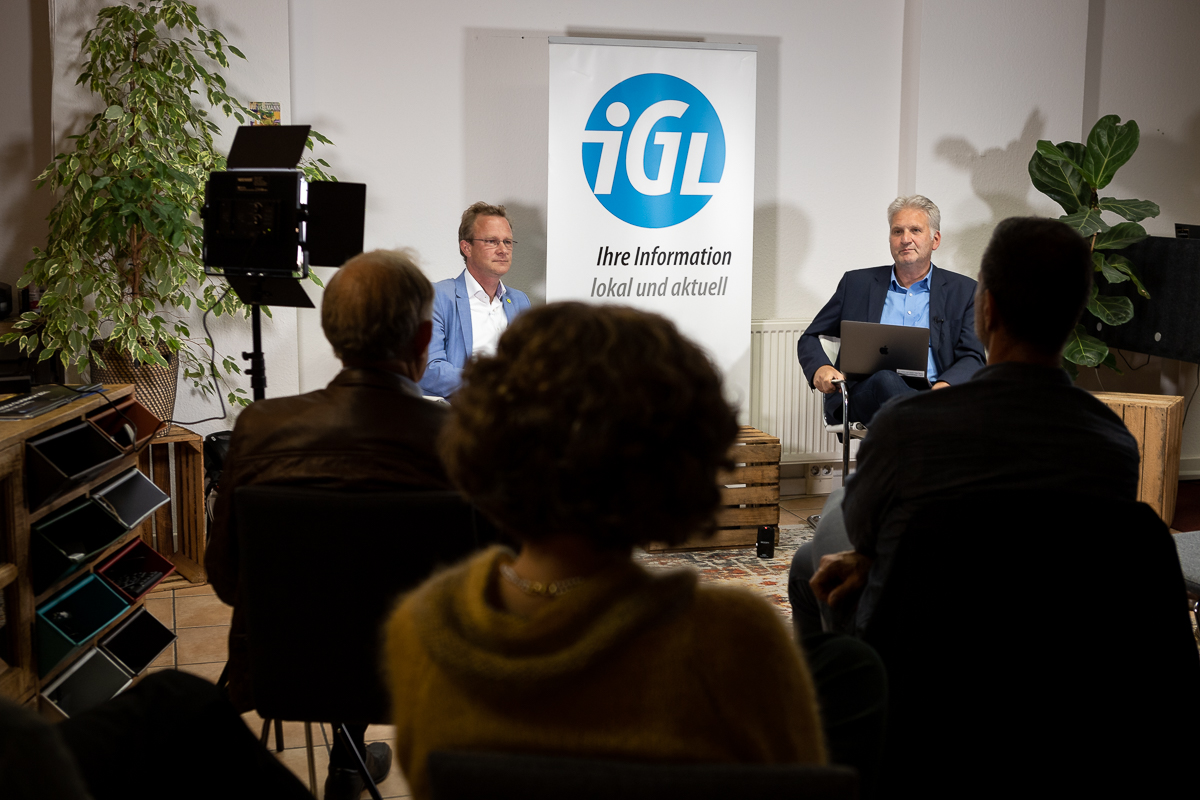
Many people think that money shouldn’t be discussed. I still believe we should talk about it. Let’s be honest: for most of us, the journalist’s heart beats a little faster than the entrepreneur’s. That’s why we should start learning from each other: how do you actually make money?
Georg Watzlawek from the Bürgerportal Bergisch Gladbach has found several answers to this question. He provided us with valuable insights into his highly diversified business model and the various revenue streams of the Bürgerportal.
At its core, community journalism relies on funding from members. For local newsrooms, which naturally have a relatively small community, this is usually not enough to cover all costs. Membership funding should be seen as a stable foundation – a kind of financial base – on which additional revenue models can be built.
Overview of the Bürgerportal Bergisch Gladbach:
- The Bürgerportal Bergisch Gladbach was founded in 2009 by Georg Watzlawek and sees itself as a “classic local newspaper,” but published only digitally and not in print.
- The daily newsletter is the Bürgerportal’s main product. Georg Watzlawek likes to describe it as a modern, digital daily newspaper. The newsletter is free, sent out every morning at 7 a.m., and provides a concise summary of what has happened and what will happen in the city. Currently, around 12,000 people subscribe to the newsletter. With additional distribution via Messenger and social media, the Bürgerportal estimates around 16,000 daily readers.
- The Bürgerportal website currently has about 160,000 unique users per month. Before the COVID-19 pandemic, Georg Watzlawek estimates the average was around 80,000–100,000.
- The Bürgerportal’s “circle of friends” has around 700 members who pay a voluntary support contribution. At the same time, the Bürgerportal does not use a paywall: all content is freely accessible to all readers.
- The community is regularly involved in reporting; they are surveyed on topics or invited to regular “BürgerClubs” and larger events, most recently for the federal election.
- The team consists of four people, with Georg Watzlawek as the only full-time employee. In addition, the Bürgerportal relies on citizen reporters who regularly write articles that are edited by the newsroom. These are usually specialized topics the citizen reporters are well-versed in.
- Clubs, organizations, or citizen initiatives can also publish their own articles or press releases on the Bürgerportal. These contributions are approved and labeled by the newsroom, giving the team more time for other tasks.
- The newsroom is located in downtown Bergisch Gladbach, right on the edge of the pedestrian zone, in a co-working space operated by the Bürgerportal since 2019.
Revenue Model of the Bürgerportal
- Advertising accounts for roughly 60–70 percent of the Bürgerportal’s revenue. The portal relies on unobtrusive banner ads on the website—nothing pops up, blinks, or annoys visitors. The daily morning newsletter also contains similar banners.
- Around 700 members of the “circle of friends” voluntarily pay an average of €7 per month to support the Bürgerportal’s work. Depending on their contribution, they receive benefits such as access to events, use of the archive, or the ability to participate in editorial decisions.
- Similar to individual memberships, the Bürgerportal offers partner programs for clubs, organizations, and businesses in Bergisch Gladbach and the surrounding region. They pay an annual contribution based on their size and financial capacity. In return, they are featured on the partner page and can, for example, use the co-working space conference rooms for free or participate in workshops. They can also post job listings in the newsletter.
- Advertorials, called “Expert Columns” at the Bürgerportal, are clearly labeled as advertising. Companies such as tax advisors, lawyers, or landscape gardeners regularly share content from their fields.
- Events like the Wahl-Arena are financed through sponsorships. The newsletter, larger article series, or video formats also regularly have sponsors.
- For video projects or larger initiatives, such as virtual tours of the city, the Bürgerportal usually works with production partners. These partnerships allow the Bürgerportal to pay less than market rates, while the partners benefit from the high reach.
- The co-working space also generates revenue for the Bürgerportal. It serves as both the newsroom workspace and a venue for smaller events.
- The Bürgerportal is always looking for new sources of income. The truth is that the small team is extremely busy with its work. Higher revenues would go directly into hiring additional staff, says Georg Watzlawek.
Lessons Learned
- People pay voluntarily: Community members enter into a social contract with the newsroom: they contribute out of conviction, wanting to support something meaningful. They are not buying content with their money, but becoming part of something larger than themselves. “We have actively decided against a paywall several times,” Georg Watzlawek said in our beabee lunchbreak in mid-August. “We focus on reach and want to reach as many people as possible; a paywall would be counterproductive.” Even though all content is free, 700 members voluntarily support the Bürgerportal, mainly because they value the newsroom’s work and consider it important.
- Advertising is still worthwhile: Especially at the local level, advertising remains an important source of funding for journalistic projects. The Bürgerportal generates the largest part of its revenue from ads. This works largely because of its high reach and visibility in Bergisch Gladbach. Community engagement is also key, as it increases visibility and strengthens the portal’s deep roots in the local society.
- Engaging businesses, clubs, and institutions: Through its partner programs, the Bürgerportal has created another important revenue stream. For relatively little effort, companies and clubs support the portal’s work for similar reasons as individual members do. It is crucial, however, that expectations are clearly defined: partnerships do not influence editorial coverage. Partner selection is also important; for example, Georg Watzlawek would not partner with the city administration of Bergisch Gladbach.
- Community involvement saves money: By having clubs and organizations contribute content themselves, the Bürgerportal can operate with relatively few staff considering the output volume. While this content is classic PR material, it still broadens the range of topics the portal covers. This lean organizational structure saves money, while clubs and organizations benefit because their issues are highlighted.
This case study was first published in our beabee newsletter, where we share practical monthly tips on community journalism. Subscribe here: Sign up
Do you have your own experiences or use cases that we should include? Just send an email to svenja.schilling@correctiv.org.