

In recent months, there has been a lot of talk about the division in society. Many people are convinced that we have forgotten how to talk to each other and tolerate differing opinions. I believe this is only partly true. What we may really need are more opportunities to engage in conversation. Formats like “Deutschland spricht” by Zeit Online have been proving this for years. When people discuss opposing viewpoints, they develop understanding for one another, break down prejudices, and help counter the polarization of our society.
Getting people talking is one of the main goals of community journalism. The ideas for formats are diverse: RUMS in Münster regularly invites the community to online discussions. The Bürgerportal Bergisch Gladbach has been hosting discussion evenings, the so-called “Bürgerclubs,” for years. Last year, the youth editorial team of CORRECTIV in Bottrop organized a barcamp on the future of the city center together with the Westdeutsche Allgemeine Zeitung. These are just three examples among many. The need for conversation in our society remains. Community-focused local newsrooms should perhaps see themselves primarily as facilitators of dialogue and exchange.
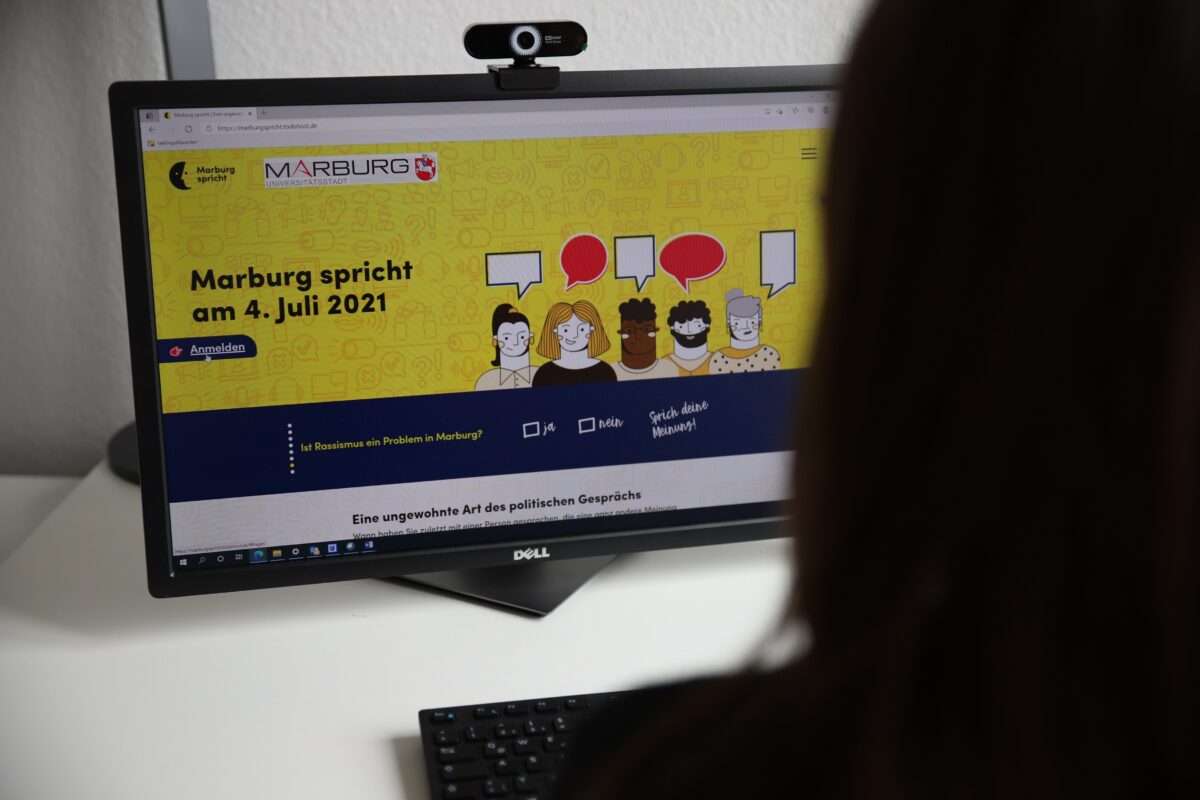
At our beabee Community Meetup in January, Sara Cooper from My Country Talks was our guest. She spoke about the project’s first local edition. “Marburg Talks” took place in July 2021. You can read about how it went here.
About My Country Talks:
- The My Country Talks project originated in 2017 at ZEIT ONLINE with the format “Deutschland spricht”.
- The ZEIT editorial team brought together 1,200 people with different political views for face-to-face conversations. Since then, the format has been exported to many other countries and, according to their own figures, has already brought tens of thousands of participants into dialogue.
- To facilitate this, My Country Talks developed software that automatically matches participants based on their answers to certain questions – always aiming to pair people with differing viewpoints.
- My Country Talks is a nonprofit organization and is funded through foundation grants, donations, and support for individual events.
How ‘Marburg Talks’ took place:
- For “Marburg Talks”, the Marburg city administration, the regional newspaper Oberhessische Presse, and the My Country Talks team joined forces. On July 4, 2021, the organizers brought together around 85 pairs of participants to engage in discussions.
- The pairs were matched in advance using My Country Talks’ software. During registration on the project website, all participants answered eight yes-or-no questions. The questions had been predetermined by the city administration:
- Should wind turbines be built within the city limits of Marburg?
- Are the measures to contain COVID-19 strict enough?
- Is racism a problem in Marburg?
- Should gender-inclusive language be used in writing and speech?
- Should nighttime patrols by the city police in Marburg be increased?
- Should expropriations be allowed to create more affordable housing?
- Is freedom of speech under threat in Germany?
- Are drivers in Marburg being unfairly disadvantaged?
- To encourage participation from as many people as possible with diverse backgrounds and viewpoints, the project collaborated with numerous local organizations, including churches, the Muslim community, sports clubs, and the university.
- Participants were matched to maximize differences in their answers to the registration questions. The conversation pairs were introduced to each other via email and could choose whether to participate. If both partners agreed, they received each other’s email addresses and arranged their meeting independently. All conversations took place privately and without moderation, though tips for good discussions were provided in advance.
- On July 4, 2021, the main event was held at a cultural center in Marburg. All participants were invited to hold their conversations there, with drinks and snacks provided.
- The Oberhessische Presse introduced some participants and their motivations beforehand, and afterwards reported on the event, including interviews with individual participants.
The Result
Satisfaction level: high – The My Country Talks team was satisfied with the first local edition and is now aiming to organize more.
- Around 170 participants took part in conversations on July 4, 2021.
- Feedback from participants was overwhelmingly positive. Many said they wanted to stay in contact with their conversation partner even after the event.
- The next local editions are already in the planning stage.
Lessons Learned
- Project partners are essential: For formats like “Marburg Talks” to work, access to different communities within the city is crucial. The goal is to ensure a diverse group of participants. Bringing many local organizations on board helps achieve this, such as religious communities, sports, cultural or neighborhood clubs, charitable organizations, volunteer agencies, and more – depending on which organizations you consider relevant.
- Conversations work best without documentation: The temptation is strong – if a media outlet initiates a great conversation format, it might seem ideal to observe some conversations and use the insights for reporting. In “Marburg Talks”, as in the nationwide editions, this did not happen for a good reason, says Sara Cooper: “It is important that the conversations take place completely privately and are not documented. Only this way do participants feel comfortable and trust to speak openly.”
- The right questions are crucial: Sara Cooper shared tips on how to ask good questions, which can also help in other community surveys:
- Starting questions with “Should” is always a good idea. It puts respondents in an active decision-making position.
- Avoid jargon, technical terms, and specialized vocabulary. While this may seem obvious, it can be tricky when asking about concrete political processes. Questions should be easily understandable for everyone and require no further explanation. In some cases, making questions less specific can help, which brings us to the last and most important tip:
- Ask about broader contexts rather than detailed political processes. Questions like “Should wind turbines be built within the city of Marburg?” are actually almost impossible to answer with a simple “Yes” or “No” because the topic is complex and involves many trade-offs. Asking it this way might seem odd at first, but it encourages participants to later explain the reasons behind their choices in the conversation. Often, they realize their counterpart does not entirely disagree. The seemingly oversimplified question often leads to more complexity in the conversation – answers are rarely just “Yes” or “No,” but rather “Yes, but…” or “No, but…”.
This case study originally appeared in our beabee newsletter, where we share hands-on tips and guidance on community journalism once a month. Subscribe to the newsletter here: Sign Up
Do you have your own experiences or use cases that we should include? Just send an email to svenja.schilling@correctiv.org.