


Surveys are a great way to involve the community in reporting. Members can share their perspectives, ask questions, and weigh in on specific topics. The Bristol Cable regularly conducts surveys with their readers, which they call “Call-Outs.” For example, a Call-Out on climate change helped The Bristol Cable discover what their members were really interested in and who could contribute as an expert. Read here to see exactly how The Bristol Cable planned, conducted, and analyzed their Climate Call-Out:
What exactly are Call-Outs?
- Call-Outs are online surveys on a specific topic or focus area that the newsroom wants to work on. The Bristol Cable regularly uses such surveys to listen in on their community.
- The Bristol Cable designs Call-Outs using different methods depending on what best fits their strategy. Open-ended questions provide real insights into the community’s thinking, closed questions give a good overview of how the community generally feels about a topic, and polls are useful for prioritizing issues.
- For example, shortly before the local elections in May, members were able to shape their agenda with the most important topics for Bristol’s politics.
How The Bristol Cable’s Climate Call-Out Worked
“Report more on the effects of climate change in Bristol!” That was a recurring request from The Bristol Cable members. No doubt, it’s an important topic, and the newsroom agreed. The challenge, however, was finding the right angle. That’s why the community was involved in planning the new focus topic from the very beginning.
Lucas Batt, Membership Coordinator at The Bristol Cable, walked us through step by step how he and the team planned, conducted, and analyzed the Call-Out. Here’s an overview of the steps:
- Develop a strategy: How can the community help with the topic of climate change?
- Create and send survey, questions, and email
- Analyze initial responses and gather feedback from participants
- Adjust and send again
- Evaluate responses
- Thank participants for their contributions
Develop a strategy: How can the community help with the issue of climate change?
- In the first step, the team defined what the engagement should achieve in this case and set a goal: “We want to bring together freelance journalists, environmental activists, Cable members, and readers to help us produce a series of articles.”
- This led to the question of what members and other readers could contribute. The team recorded the answers on a Google Jamboard:
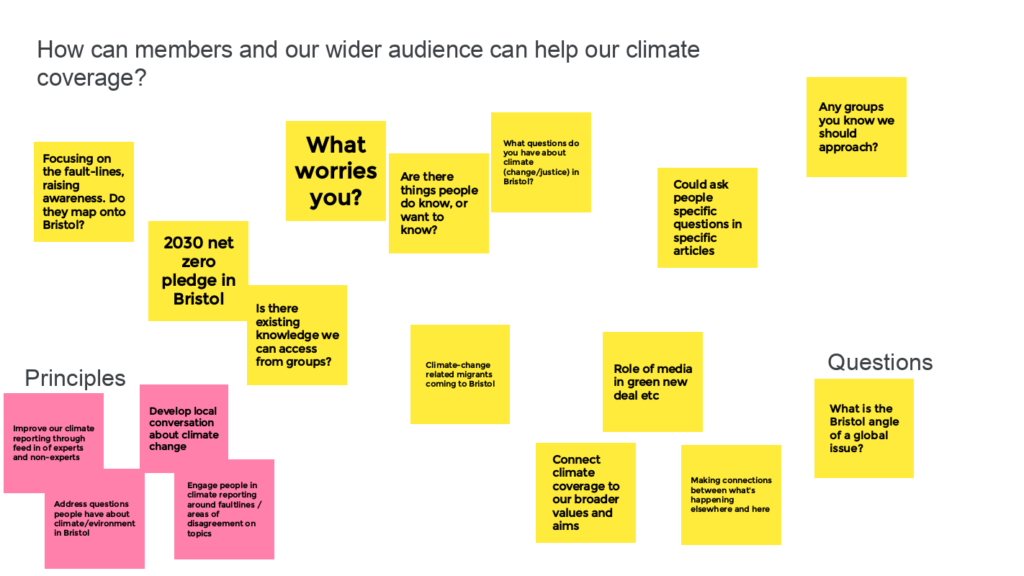
The Google Jamboard the team used to collaboratively answer the question.
- The team also identified potential collaboration partners in advance, such as freelance journalists who had already worked on environmental topics and local climate-action organizations.
- In the long term, the goal is to create an “infrastructure” to generally improve The Bristol Cable’s reporting on environmental issues.
- Lucas documented all goals and potential partners in an engagement strategy.
Create question list, survey, and email
- Based on the engagement strategy, Lucas developed the questionnaire and came up with a total of five questions:
- What would you like to know about Bristol’s role in climate change, for example how Bristol’s businesses contribute or how the city is tackling it? (open-ended)
- What questions do you have about the impact climate change will have on Bristol? (open-ended)
- Are there specific topics or issues we should report on related to climate change? (open-ended)
- Are you an expert on climate change, or have you personally experienced its effects? (Yes/No)
- Would you like us to send you regular email updates on climate and environmental topics? (Yes/No)
- To create the survey, Lucas used The Bristol Cable’s own member-system survey tool. Google Forms or Typeform would have worked just as well in this case.
- Lucas created the email to promote the Call-Out in Mailchimp. Here’s the final version:
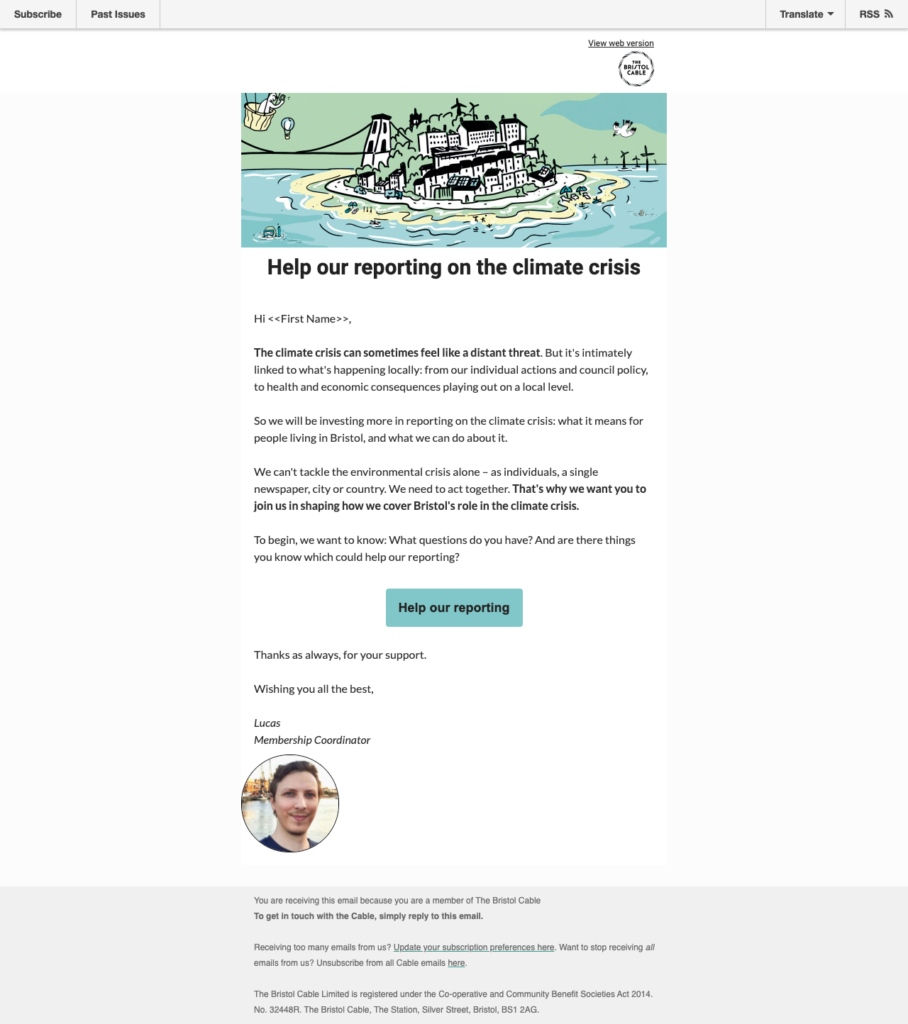
The email Lucas sent to the community.
- Before sending the Call-Out, everything was checked one last time: Were there any mistakes? How does the email layout look? Does the survey work? etc.
- Afterwards, the emails were sent to two Mailchimp lists: members and non-members.
Analyze initial responses and gather feedback
- In the first 24 hours, the initial responses started coming in, mainly from members. The same happened after a reminder about the Call-Out was included in The Bristol Cable’s weekly newsletter two days later.
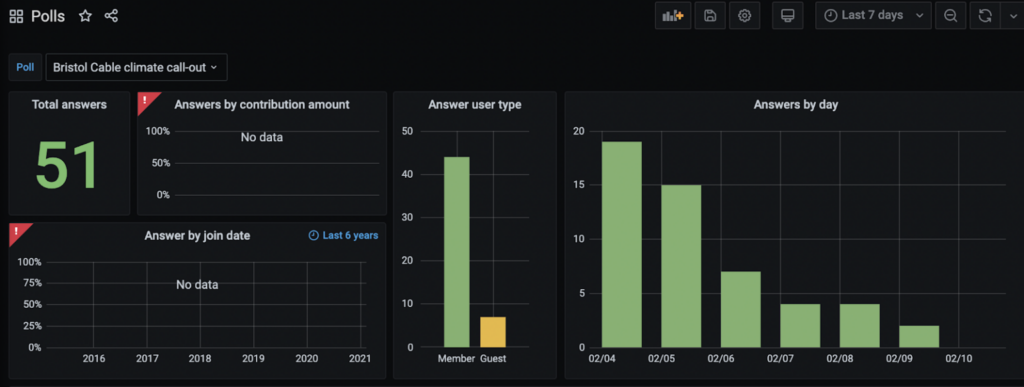
The Bristol Cable uses Grafana to visualize the responses to Call-Outs.
- The analysis of the responses was then carried out along two categories:
- Questions and ideas for reporting
- Identification of experts
- The team recorded the responses to each question in a table so they could be quickly scanned and used, and to identify potential experts.
- At the same time, the team sent a feedback survey to particularly engaged Bristol Cable members: Did they see the Call-Out? Was the survey easy to understand? Was it difficult to provide answers? What could be improved?
Adjust and send again
- The feedback made it clear: the survey was very well received. However, one problem was that most people simply hadn’t seen the Call-Out.
- The team therefore drafted a new email and sent the Call-Out again—unchanged—but only to those who hadn’t responded yet.
Analyze responses
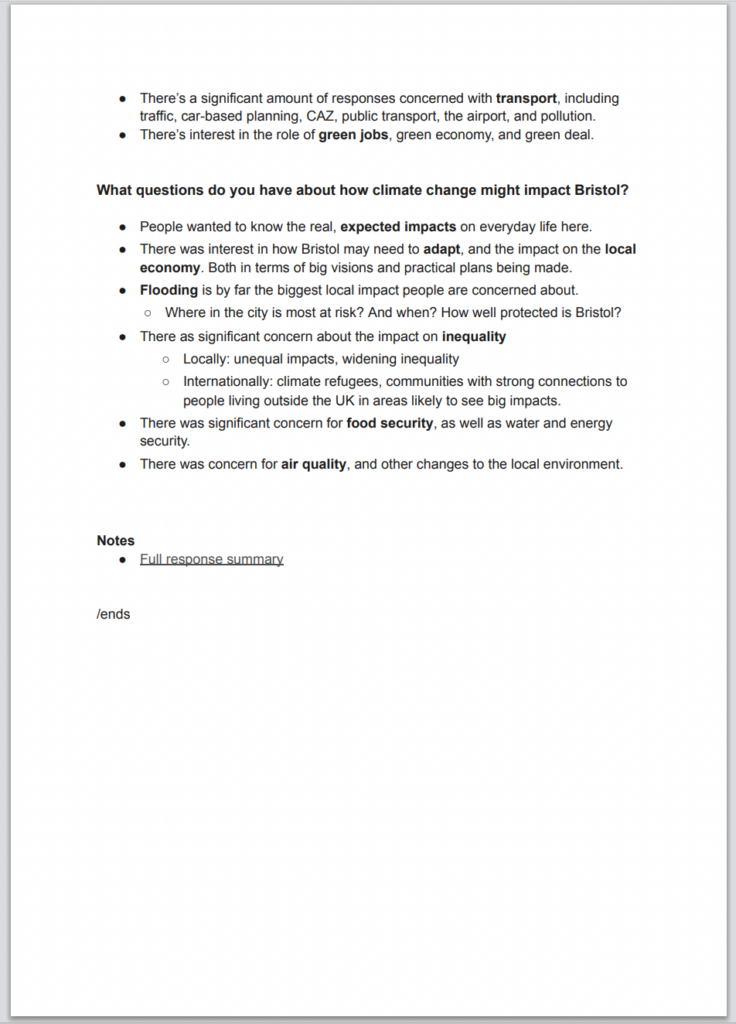
- In total, around 118 people responded to the Call-Out. Lucas compiled their answers in a large Google Doc, organized them by theme, and highlighted key points.
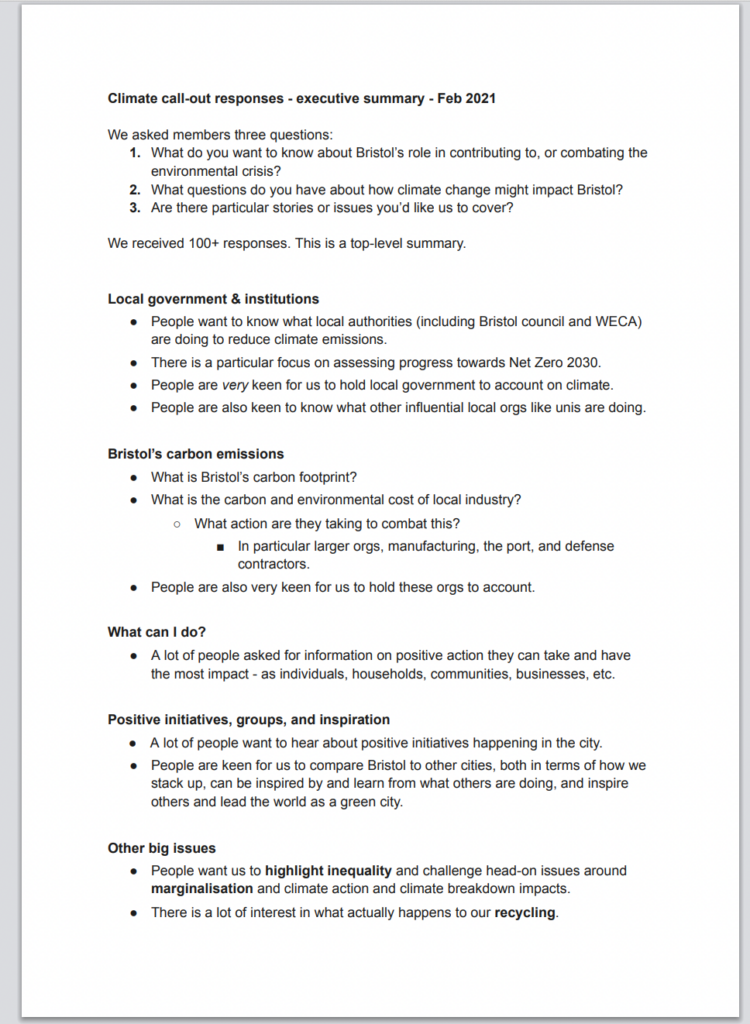
- In the end, the document was about 30 pages long—too extensive for practical use in the newsroom. Lucas therefore created a short version summarizing the main topics and most common questions on just two pages.
- Lucas has made the short version available to us:
Thank participants for their contributions
- Shortly after the Call-Out, the newsroom sent an email to everyone to thank them for participating and to explain what would be done with the responses.
- Participants with expert knowledge or unique stories are contacted separately, for example by email or phone.
The Result
Satisfaction level: high – The Bristol Cable is very pleased with the outcome of the Call-Out, as they received many valuable responses and were able to identify experts.
- 118 people responded to the Call-Out, submitting their questions about climate change in Bristol.
- The newsroom now has a comprehensive collection (30 pages in total) of questions from the community, which they can use to guide research and report on the climate topics that truly interest their audience. One of the most common questions was, for example, when and how sea-level rise will affect the port city of Bristol.
- The newsroom now has contact with several experts who are well-versed in specific aspects of the topic and can assist with research. They have tagged these people in their membership database to easily find them later. Other forms of participation are also possible: for example, experts could help with fact-checking before articles are published, take part in panel discussions, or engage in expert roundtables with others – activities that can further enrich the reporting.
What We Learned
- Good planning is everything: It’s important to carefully consider what the community can and should contribute. Being clear about this from the start saves a lot of time later during analysis. Especially smaller teams should think carefully about their goals and what they can realistically achieve to avoid overextending themselves.
- The biggest effort is in the analysis: Few newsrooms have a Membership Coordinator like Lucas at The Bristol Cable. He spent two full days reading, sorting, and summarizing the responses. Therefore: ask only as many questions as you can realistically analyze – but make them the right ones. Another option is to delegate the analysis, for example to volunteers from the community or students looking to earn some extra income.
- Don’t be afraid of a second attempt: If it turns out despite careful preparation that the questions or the email approach don’t work, it can be useful to revise everything and send it again. The same applies if the Call-Out receives little attention.
- Quantity is secondary: Less than 5% of The Bristol Cable members responded to the Climate Call-Out. The outcome is still valuable, as the newsroom now has several starting points for research and contacts with some experts.
- It’s also about the process: Community members who didn’t participate in the Call-Out still know that the newsroom is listening and that the reporting is the result of collaboration with the community. Part of the newsroom’s work now includes repeatedly highlighting community involvement in their articles.
This case study first appeared in our beabee newsletter. In it, we share practical tips and guides once a month on how community journalism works. You can subscribe to the newsletter here: Sign up
Do you have your own experiences or use cases that we should include? Just send an email to svenja.schilling@correctiv.org.